
Self-driving 2D heterostructure fabrication
Robotic exfoliation, stacking, characterization, and sample archiving create a repeatable loop for building 2D materials.
A Utah Programmable Cloud Laboratory Node
AURORA connects robotic 2D materials fabrication, characterization, AI-driven scientific reasoning, and CloudLab-proven cyberinfrastructure into an open facility for reproducible discovery.
Programmable laboratory
Robotic exfoliation, stacking, characterization, and sample archiving create a repeatable loop for building 2D materials.
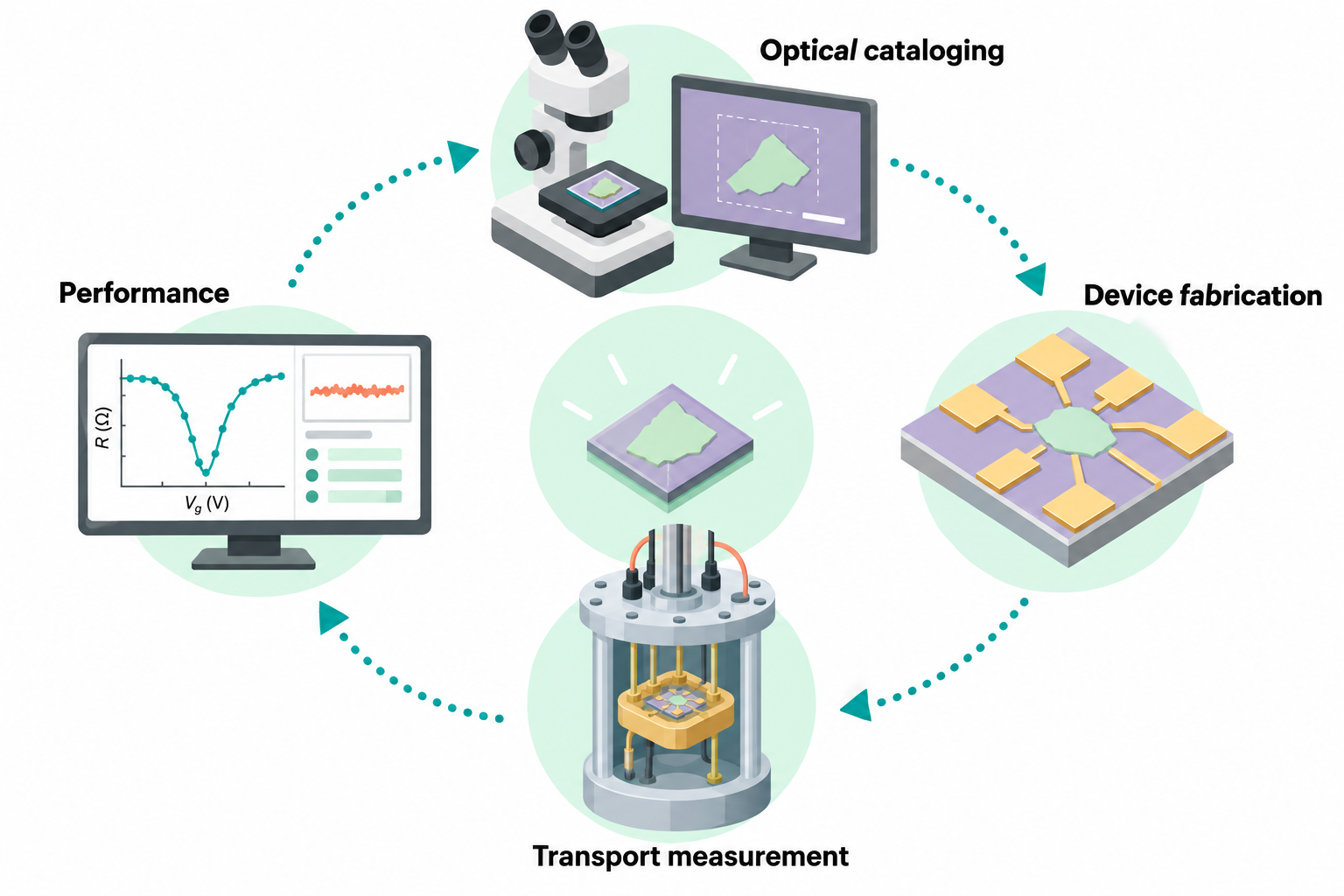
Optical cataloging, device fabrication, and transport measurements connect sample state to experimental performance.

Physics-informed descriptors, cross-modal models, and interpretable learning help propose and refine the next experiment.

Users can fork production workflows into isolated sandboxes, validate changes, and merge improvements back into stable PCL operation.

AURORA connects synthesis, exfoliation, optical metrology, heterostructure fabrication, device packaging, cryogenic measurement, and AI-driven hypothesis generation into one programmable workflow.
Scientific focus
Manual assembly of 2D samples can produce different electronic behavior even within the same lab. AURORA turns fabrication parameters, observation, and analysis into a programmable loop, making materials discovery easier to repeat, compare, and scale.
Reproducible phase diagrams for correlated, superconducting, and topological phases.
AI-guided materials selection across topological insulator and ferromagnetic interfaces.
Open access to moire superlattices, Hubbard-model simulators, and systematic phase mapping.
Preview
Personnel


To be determined
To be determined
To be determined
To be determined
Open facility
AURORA pairs hands-on training with remote experiment control, isolated compute environments, and user research practices shaped by years of operating CloudLab for academic and industry communities.
Connect by filling out this user interest form and help us shape what's next!
